Webbed finger or toe repair
Definition
Webbed finger or toe repair refers to corrective or reconstructive surgery performed to repair webbed fingers or toes, also called syndactyly. The long and ring fingers or the second and third toes are most often affected. Generally, syndactyly repairs are done between the ages of six months and two years.
Purpose
Webbing, or syndactyly, is a condition characterized by the incomplete separation or union of two or more fingers or toes, and usually only involves a skin connection between the two (simple syndactyly), but may—rarely—also include fusion of bones, nerves, blood vessels, and tendons in the affected digits (complex syndactyly). Webbing may extend partially up between the digits, frequently just to the first joint, or may extend the entire length of the digits. Polysyndactyly describes both webbing and the presence of an extra number of fingers or toes. The condition usually develops within six weeks after birth. Syndactyly can also occur in victims of fires, as the intense heat can melt the skin and fuse the epidermis and dermis of the phalanges, fingers, or toes. Burn victim syndactyly is always less invasive because bone fusion is not present in these cases. The purpose of repair surgery is to improve the appearance of the hand or foot and to prevent progressive deformity from developing as the child grows.
Demographics
In the United States, approximately one infant in every 2,000 births is born with webbed fingers or toes. Both hands are involved in 50% of cases; the middle finger and ring finger in 41%; the ring finger and little finger in 27%; the index finger and middle finger in 23%; and the thumb and index finger in 9%.
Description
Polydactyly can be corrected by surgical removal of the extra digit or partial digit. Syndactyly can also be corrected surgically. This is usually accomplished with the addition of a skin graft from the groin.
There are several ways to perform this type of surgery; the design of the operation depends both on the features of the hand or foot and the surgeon's experience. The surgery is usually performed with zigzag cuts that cross back and forth across the fingers or toes so that the scars do not interfere with growth of the digits.
The procedure is performed under general anesthesia. The skin areas to be repaired are marked and the surgeon then proceeds to incise the skin, lifting small flaps at the sides of the fingers or toes and in the web. These flaps are sutured into position, leaving absent areas of skin. These areas may be filled in with full thickness skin grafts, usually taken from the skin in the groin area.
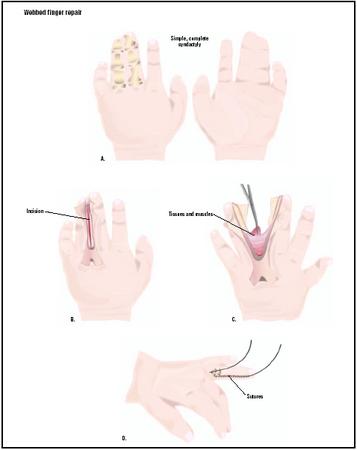
The hand or foot is then immobilized with bulky dressings, or a cast. Webbed or toe repair surgery usually takes two to four hours.
Diagnosis/Preparation
Syndactyly may be diagnosed during an examination of an infant or child, with the aid of x rays. In its most common form, it is seen as webbing between the second and third toes. This form is often inherited. Syndactyly can also occur as part of a pattern of other congenital defects involving the skull, face, and bones.
An infant with webbed fingers or toes may have other symptoms that, when observed together, define a specific syndrome or medical condition. For example, syndactyly is a characteristic of Apert syndrome, Poland syndrome, Jarcho-Levin syndrome, oral-facial-digital syndrome, Pfeiffer syndrome, and Edwards syndrome. Diagnosis of a syndrome is made on family history, medical history, and thorough physical evaluation. The medical history questions documenting the condition in detail usually include:
- Which fingers (toes) are involved?
- Are any other family members affected by the same condition?
- What other symptoms or abnormalities are also present?
To prepare for surgery, seven to 10 days before surgery, the child visits the family physician or pediatrician for a general physical examination and blood tests. The child cannot have solid food after midnight before surgery. Breast milk, formula, or milk (no pablum or other cereal may be added) up to six hours before the scheduled start of surgery is allowed, and then only clear fluids up to three hours before surgery. Thereafter, the child may not have anything else to eat or drink.
Aftercare
Hospital stays of one or two days are common for webbed finger or toe repair surgery. There is usually some swelling and bruising. Pain medications are given to alleviate any discomfort. The bandages must be kept clean and dry and must remain for two to three weeks for proper healing and protection. Skin grafts and the hand or foot may become very dry, so it is encouraged to dampen them with a good moisturizer such as Lubriderm or Nivea. Small children with hand syndactylies may have a cast put on that extends above the flexed elbow. Sometimes, the cast extends beyond the fingers or toes. This protects the repaired areas from trauma.
The treating physician should be informed of any post-operative swelling, severe pain, fever, or fingers that tingle, are numb, or have a bluish discoloration.
Risks
Webbed finger or toe repair surgery carries the risks associated with any anesthesia, such as adverse reactions to medications, breathing problems, and sore throat from intubation. Risks associated with any surgery are excessive bleeding and infection.
Specific risks associated with the repair surgery include possible loss of skin graft and circulation damage from the cast or bandages.
Normal results
The results of webbed finger or toe repair depend on the degree of fusion of the digits and the repair is usually successful. When joined fingers share a single fingernail, the creation of two normal-looking nails is rarely possible. One nail will look more normal than the other. Some children may require a second surgery, depending on the type of syndactyly. If polydactyly or syndactyly are just cosmetic and not symptomatic of a condition or disorder, the outcome of surgery is usually very good. If it is symptomatic, the outcome will rely heavily on the management of the disorder.
Alternatives
Syndactyly does not generally pose any health risk, so that it is not mandatory that the repair be performed. However, if the thumb is joined, or if the fingers are joined out toward their tips, they will grow in a progressively worsening bend over time.
See also Cleft lip repair ; Club foot repair .
Resources
books
Jones, Kenneth Lyons. Smith's Recognizable Patterns of Human Malformation. 5th ed. Philadelphia: W.B. Saunders, 1997.
Moore, K. L., and T. V. N. Persaud. Before We Are Born: Essentials of Embryology and Birth Defects. New York: Elsevier Science, 2003.
periodicals
Ad-El, D. D., Neuman, A., and A. Eldad. "Syndactyly repair in kindler syndrome." Plastic and Reconstructive Surgery 111 (January 2003): 504-505.
Benatar, N. "The open finger technique for release of syndactyly." The Journal of Hand Surgery: Journal of the British Society for Surgery of the Hand 26 (October 2001): 500-501.
Deunk, J., Nicolai, J. P., and S. M. Hamburg. "Long-term results of syndactyly correction: Full-thickness versus split-thickness skin grafts." The Journal of Hand Surgery: Journal of the British Society for Surgery of the Hand 28 (April 2003): 125-130.
Greuse, M., and B. C. Coessens. "Congenital syndactyly: defatting facilitates closure without skin graft." Journal of Hand Surgery (American) 26 (July 2001): 589-594.
Takagi, S., Hosokawa, K., Haramoto, U., and T. Kubo T. "A new technique for the treatment of syndactyly with osseous fusion of the distal phalanges." Annals of Plastic Surgery 44 (June 2000): 660-663.
organizations
The American Academy of Orthopaedic Surgeons. 6300 North River Road, Rosemont, Illinois 60018-4262. (847) 823-7186; (800) 346-AAOS. http://www.aaos.org .
The American Society for Surgery of the Hand. 6300 North River Road, Suite 600, Rosemont, Illinois 60018-4256. (847) 384-8300. http://www.assh.org .
Office of Rare Diseases (NIH). 6100 Executive Boulevard, Room 3A07, MSC 7518 Bethesda, Maryland 20892-7518. (301) 402-4336. http://rarediseases.info.nih.gov/infodiseases.html .
other
"Before and after webbed finger repair." Medline Plus. http://www.nlm.nih.gov/medlineplus/ency/imagepages/10034.htm .
"Repair of webbed fingers or toes." PennHealth. http://www.pennhealth.com/ency/article/002969.htm
Monique Laberge, Ph.D.
WHO PERFORMS THE PROCEDURE AND WHERE IS IT PERFORMED?
Webbed finger or toe repair surgery is usually performed in a children's hospital by a pediatric surgeon or orthopedic surgeon specializing in syndactyly surgery.
If prenatal screening indicates syndactyly in the fetus, arrangements are usually made so that the baby is delivered at a hospital with a pediatric surgeon on staff.
QUESTIONS TO ASK THE DOCTOR
- What will happen during the surgery?
- Does my baby have any other birth defect?
- How long will it take to recover from surgery?
- Will my baby have normal fingers/toes?
- How many webbed finger/toe repair surgeries do you perform each year?
- Will the syndactyly return?
Thank YOu!
Thank YOu!
but i recently decided to get surgery and i think i made a mistake. I lost the skin draft. now i have to get in the operation room again. I was in a lot of pain and i am not even sure that it was worth it. It still does not look normal.
And so, I had the surgery yesterday/about 16 hours ago - it took about 1 1/2 hours {the Dr. took a small skin graft from the crease in my thigh, to hide any possible scar} and I went home about an hour later, I've been taking my pain meds, using ice packs, keeping my feet elevated. No real discomfort thus far but from what I've found on-line, day 2 is the worst so I'm a bit worried but I truly think that it will be well worth it. My nurse told me they look great, I won't get the bandages off for week.
If anyone has questions or advice please feel free to comment!
My graft was taken from my hip/bikni line and it around 5 inches long.
I would reccomend this if your realy unhappy but it is such a long process and overall it dosent look properly healed and faded until around 3 years after the operation.
Any more questions please ask.
Chloe
to the people who doesn't like the way they are: be proud of who you are. i don't believe in the better make-up better life concept. it can be a help, but a bigger help is: use your 'weakness' to become your 'strength'..self confidence comes from the soul. another of my very beliefs is that humour and self distance are keys to success in love affairs and to every aspect of life... how about the indian name big toe? i like it :D joke aside i believe in what we are gifted with from our parents and grandparents and to do beautiful things with that!
viewed from aestethism, which hopefully is a bit different for different people, natural is however better than cutting open. and think of using skin from the groin..what an intervention! even if a chirurg is at hers or his most perfect it is very impossible to make it look 'normal' or 'natural'. so don't take the risk if you are doing it only for the ''normal' looks'.
- i now must also tell the story of my shoulder that came out of place a several times in my life. since the ligaments become loser for every luxation, it happend more and more frequently.. by the fourth time i managed to put it back into place on my own. considering an operation i learned they would take a piece of bone from my shoulderblade and fix it in front of my shoulder to block the upper arm to jump out any more. this could and would certainly cause a limited arm movement capacity. so i did not operate. but since that year, 2007, my shoulder is in perfect shape and the arm does not jump out anymore. i have healed from numbness as well, mainly thanks to shiatsu /tcm and bodywork. i managed to go beyond the 'mechanical' thinking and perception of the body that i used to have once a teenager. this is very interesting to me.. -
- so, when it comes to operating syndactly; if it's for the practical reason i understand but please reconsider before operating - there are so many other ways! i wish everybody good luck and that everything goes well!
My 3 year old also has 4th and 5th webbed toes...at his 3 year appt my Pediatrician recommended seeing an Orthopedic Surgeon. Now I am doing research since as an infant I was told it was not necessary...by the same doc. Very confused. But most posts I read sound like teenagers and adults are not happy with their appearance with webbed toes. Depression runs in my family, and bullying seems to be big in the news. I am not sure if I want to put my child through the teasing...but the procedure sounds painful for my baby boy...just not sure what to do.
I have a son his about 6 yrs old and his short/ring/middle finger a all joint together, just inquiring can the fingers be separated or not because we can only feel the bones for 2 fingures not 3
just wondering can it be done or not
thanks
am in africa.
I would like to get another opinion to rectify my situation.
Can you recommend a doctor who performs surgery on adults? I'm in the NY/NJ area.
Thanks
This is for an adult. Thanks
In my childhood days my three fingers were straightly joint.. doctor operated in such a way that three finger curled up together.. Now I have started developing itching and scars on my fingers... Can I get it operated now and way measures and questions do i need to ask doctors...
Thank you for your help!
walk barefoot on the beach etc. I go online to look for some sort of sandals that cover my toes and i never find one. One thing that if i wear
close shoes it hurt so much and i get callus. I would like to get rid of this because it give me a hard time.
Im looking forward to wear an open shoes that i haven't experience for my whole life.
Hope you can help me.
on the beach. Now it hard for me especially if i wear a close shoes at work , it give me a hard time because i always got a callus and its very painful.
I would like to get rid of this. So that i can experience to wear an open sandal without any hesitation to other people.
I would like to know how the cost of this procedure.
Hope you can help me. Thank you.
My daughter was born with web toes on both feet between the second and third toes.I am not aware of any family inheritance of this.I am trying to look for an organization like, I want to operate it.