Tonsillectomy
Definition
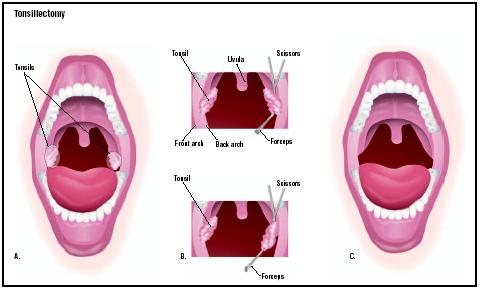
Tonsillectomy is a surgical procedure to remove the tonsils. The tonsils are part of the lymphatic system, which is responsible for fighting infection.
Purpose
Tonsils are removed when a person, most often a child, has any of the following conditions:
- obstruction
- sleep apnea (a condition in which an individual snores loudly and stops breathing temporarily at intervals during sleep)
- inability to swallow properly because of enlarged tonsils
- a breathy voice or other speech abnormality due to enlarged tonsils
- recurrent or persistent abscesses or throat infections
Physicians are not in complete agreement on the number of sore throats that necessitate a tonsillectomy. Most would agree that four cases of strep throat in any one year; six or more episodes of tonsillitis in one year; or five or more episodes of tonsillitis per year for two years indicate that the tonsils should be removed.
Demographics
A tonsillectomy is one of the most common surgical procedures among children. It is uncommon among adults. More than 400,000 tonsillectomies are performed
Description
A tonsillectomy is usually performed under general anesthesia, although adults may occasionally receive a local anesthetic. The surgeon depresses the tongue in order to see the throat, and removes the tonsils with an instrument resembling a scoop.
Alternate methods for removing tonsils are being investigated, including lasers and other electronic devices.
Diagnosis/Preparation
Tonsillectomy procedures are not performed as frequently today as they once were. One reason for a more conservative approach is the risk involved when a person is put under general anesthesia.
In some cases, a tonsillectomy may need to be modified or postponed:
- Bleeding disorders must be adequately controlled prior to surgery.
- Acute tonsillitis should be successfully treated prior to surgery. Treatment may postpone the surgery three to four weeks.
Aftercare
Persons are turned on their side after the operation to prevent the possibility of blood being drawn into the lungs (aspirated). Vital signs are monitored. Patients can drink water and other non-irritating liquids when they are fully awake.
Adults are usually warned to expect a very sore throat and some bleeding after the operation. They are given antibiotics to prevent infection, and some receive pain-relieving medications. For at least the first 24 hours, individuals are instructed to drink fluids and eat soft, pureed foods.
People are usually sent home the day of surgery. They are given instructions to call their surgeon if there is bleeding or earache, or fever that lasts longer than three days. They are told to expect a white scab to form in the throat between five and 10 days after surgery.
Risks
There is a chance that children with previously normal speech will develop a nasal-sounding voice. In addition, children younger than five years may be emotionally upset by the hospital experience. There are risks associated with any surgical procedure, including post-operative infection and bleeding.
Normal results
Normal results include the correction of the condition for which the surgery was performed.
Morbidity and mortality rates
Morbidity other than minor post-surgical infection is uncommon. About one in every 15,000 tonsillectomies ends in death, either from the anesthesia or bleeding five to seven days after the operation.
Alternatives
There are no alternatives to surgical removal of the tonsils. Drug therapy may be used for recurrent infections involving the tonsils.
See also Adenoidectomy .
Resources
books
Bland, K.I., W.G. Cioffi, M.G. Sarr. Practice of General Surgery. Philadelphia: Saunders, 2001.
Braunwald, E., D.L. Longo, J.L. Jameson. Harrison's Principles of Internal Medicine, 15th ed. New York: McGraw-Hill, 2001.
Goldman, L. & J.C. Bennett. Cecil Textbook of Medicine, 21st ed. Philadelphia: Saunders, 1999.
Schwartz, S.I., J.E. Fischer, F.C. Spencer, G.T. Shires, J.M. Daly. Principles of Surgery, 7th ed. New York: McGraw Hill, 1998.
Townsend, C., K.L. Mattox, R.D. Beauchamp, B.M. Evers, D.C. Sabiston. Sabiston's Review of Surgery, 3rd ed. Philadelphia: Saunders, 2001.
periodicals
Remacle, M., J. Keghian, G. Lawson, J. Jamart. "Carbon-dioxide Laser-assisted Tonsil Ablation for Adults with Chronic Tonsillitis: A 6-month Follow-up Study." European Archives of Otorhinolaryngology 260, no.4 (2003): 243-6.
Silveira, H., J.S. Soares, H.A. Lima. "Tonsillectomy: Cold Dissection Versus Bipolar Electrodissection." International Journal of Pediatric Otorhinolaryngology 67, no.4 (2003): 345-51.
Werle, A.H., P.J. Nicklaus, D.J. Kirse, D.E. Bruegger. "A Retrospective Study of Tonsillectomy in the Under 2-Year-Old Child: Indications, Perioperative Management, and Complications." International Journal of Pediatric Otorhinolaryngology 67, no.5 (2003): 453-60.
Yaremchuk, K. "Tonsillectomy by Plasma-Mediated Ablation." Archives of Otolaryngology Head and Neck Surgery 129, no.4 (2003): 498-9.
organizations
American College of Surgeons. 633 North St. Clair Street, Chicago, IL 60611-32311. (312) 202-5000. Fax: (312) 202-5001. E-mail: http://postmaster@facs.org. http://www.facs.org .
American Academy of Otolaryngology-Head and Neck Surgery. One Prince St., Alexandria, VA 22314-3357. (703) 836-4444. http://www.entnet.org/index2.cfm .
American Cancer Society. 1599 Clifton Road NE, Atlanta, GA 30329. (800) 227-2345. http://www.cancer.org .
American Osteopathic College of Otolaryngology-Head and Neck Surgery. 405 W. Grand Avenue, Dayton, OH 45405. (937) 222-8820 or (800) 455-9404, fax (937) 222-8840. Email: http://info@aocoohns.org.
other
Columbia University School of Medicine. [cited May 5, 2003] http://www.entcolumbia.org/t-aproc.htm .
Eastern Virginia Medical School. [cited May 5, 2003] http://www.evmsent.org/ped_ops/tonsillectomy.html .
National Library of Medicine. [cited May 5, 2003] http://www.nlm.nih.gov/medlineplus/ency/article/003013.htm .
University of California-San Diego. [cited May 5, 2003] http://www-surgery.ucsd.edu/ent/PatientInfo/instructions_tonsillectomy.html .
University of Florida. [cited May 5, 2003] http://www.ent.health.ufl.edu/patient%20info/T&A.htm .
L. Fleming Fallon, Jr., MD, Dr.PH.
WHO PERFORMS THE PROCEDURE AND WHERE IS IT PERFORMED?
A tonsillectomy is performed in an outpatient facility associated with a hospital by a general surgeon or otolaryngologist (physician who specializes in treating disorders of the ear, nose, and throat).
QUESTIONS TO ASK THE DOCTOR
- What will be the resulting functional status of the body after the operation?
- Is the surgeon board certified in head and neck surgery?
- How many tonsillectomy procedures has the surgeon performed?
- What is the surgeon's complication rate?
- Has the surgeon operated on children?
is there any risk or compications for adults (61 years old), to have tonsillectomy?
if so, what are they?
Can this be caused easily by a tonsillectomy or is it a rare occurence and why it is so rare?
thank you
My 4 yrs son is suffering every night, he hardly swollow, he is a mouth breather, he snores, he can
t express what hurts, but I i can understand that it hurts?
I'm afraid to do the operation, Is there any other way??
Kindly please reply on my email. thanks
He nurses still, but Im worried if he wont drink after.
and I was wondering if they bleed on the 2 week when you got down with the surgry.
Regards
Cindy
Thankyou, I will keep an eye on my email for a reply
please send answer to..amna-only@hotmail.com
from sudan>>>with thanks
my 4 and 1/2 year old daughter has got the tonsillitis. during the last three months she suffered twice the infection and the doctors prescribed Zinnet and Augmentin antibiotic. I am afraid what is next. I do not want to go for surgery. is there any other way or any homeopathy or ayurvedic treatment available? Please do reply.
thanks
Is normal for tongue to be be whiteish after
Even brushing
is this normal, becuase it is worse then the pain in my throat.
My 19months old daughter had tonsiilectomy on the 18th of November 2011. After the operation she stopped eating and drinking. She was kept in the hospital for 4 days. Everyday she is drinking only 250/300ml water, juice. She used to be bottle fed and used to drink 500ml milk everyday but after the operation she is not touching the bottle at all.Though she is still active. I am giving her some pain relieves madicine and atibiotics which is given by doctor. Do you think She will be alright? or I've to take her to the hospital again. Please suggest.
I'm a 38 year old that had my tonsils taken out Oct 20th 2011. And I still have a problem tasting foods and liquids they all have a bitter taste or after taste to it.And my muscles in my throat seem to feel tight when I swallow yet.I had told my doctor for my check-up app and was told to take prilosec otc for 14 days did that and no difference. I thought it was all part of a healing process for my age but, I am getting fustrated with not being able to taste my foods a drinks. Please help
is it possable for tonsilectomy to'be done twice within 12 months? I was operated on for tonsilitis 5 months ago but now i am still feel the same symtoms i was feelling before the operation. Please if this is normal or if the tonsilitis is back again.
i do have tonsilitis , im taking eretromycin 1/day and cloaxacillin 3/day but it seems recovery
is too slow, but my very concern is that, in a few week is my flight going to Qatar and i need to recover asap for my medical unless i am sending back. what will i do?
~~i just want to ask, what are the do's and dont's after tonsillectomy. i didn't ask my doctor about it yet. just so scared about my upcoming operation. :) hope to hear feedback from this blog.:)
is there any postive cmments regarding the procedure? any good experience?
So all I need to know is if I cut my tonsils off. would I face any complications in near future??
Please advice.
What are the tonsillectomy complications for a child?
Afte 4 month my tonsillectomy surgery again I am facing throat infection and throat seem to feel tight when I swallow yet. sometimes I am feeling eching and ear pain.