Nephrectomy
Definition
A nephrectomy is a surgical procedure for the removal of a kidney or section of a kidney.
Purpose
Nephrectomy, or kidney removal, is performed on patients with severe kidney damage from disease, injury, or congenital conditions. These include cancer of the kidney (renal cell carcinoma); polycystic kidney disease (a disease in which cysts, or sac-like structures, displace healthy kidney tissue); and serious kidney infections. It is also used to remove a healthy kidney from a donor for the purposes of kidney transplantation .
Demographics
The HCUP Nationwide Inpatient Sample from the Agency for Healthcare Research and Quality (AHRQ) reports that 46,130 patients underwent partial or radical nephrectomy surgery for non-transplant-related indications in the United States in 2000. Patients with kidney cancer accounted for over half of those procedures. The American Cancer Society projects that an estimated 31,900 new cases of renal cell carcinoma will occur in the United States in 2003.
According to the United Network for Organ Sharing (UNOS), 5,974 people underwent nephrectomy to become living kidney donors in 2001. The majority of these donors—43.9%—were between the ages of 35 and 49, and 58.8% were female. Related donors were more common than non-related donors, with full siblings being the most common relationship between living donor and kidney recipients (28.5% of living donors).
Description
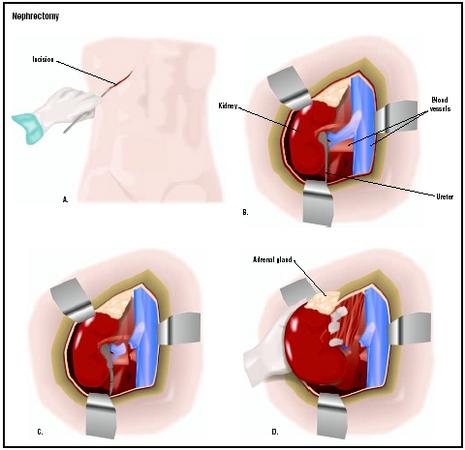
Nephrectomy may involve removing a small portion of the kidney or the entire organ and surrounding tissues. In partial nephrectomy, only the diseased or infected portion of the kidney is removed. Radical nephrectomy involves removing the entire kidney, a section of the tube leading to the bladder (ureter), the gland that sits atop the kidney (adrenal gland), and the fatty tissue surrounding the kidney. A simple nephrectomy performed for living donor transplant purposes requires removal of the kidney and a section of the attached ureter.
Open nephrectomy
In a traditional, open nephrectomy, the kidney donor is administered general anesthesia and a 6–10 in (15.2–25.4 cm) incision through several layers of muscle is made on the side or front of the abdomen. The blood vessels connecting the kidney to the donor are cut and clamped, and the ureter is also cut between the bladder and kidney and clamped. Depending on the type of nephrectomy procedure being performed, the ureter, adrenal gland, and/or surrounding tissue may also be cut. The kidney is removed and the vessels and ureter are then tied off and the incision is sutured (sewn up). The surgical procedure can take up to three hours, depending on the type of nephrectomy being performed.
Laparoscopic nephrectomy
Laparoscopic nephrectomy is a form of minimally invasive surgery that utilizes instruments on long, narrow rods to view, cut, and remove the kidney. The surgeon views the kidney and surrounding tissue with a flexible videoscope. The videoscope and surgical instruments are maneuvered through four small incisions in the abdomen, and carbon dioxide is pumped into the abdominal cavity to inflate it and improve visualization of the kidney. Once the kidney is isolated, it is secured in a bag and pulled through a fifth incision, approximately 3 in (7.6 cm) wide, in the front of the abdominal wall below the navel. Although this surgical technique takes slightly longer than a traditional nephrectomy, preliminary studies have shown that it promotes a faster recovery time, shorter hospital stays, and less post-operative pain.
A modified laparoscopic technique called hand-assisted laparoscopic nephrectomy may also be used to remove the kidney. In the hand-assisted surgery, a small incision of 3–5 in (7.6–12.7 cm) is made in the patient's abdomen. The incision allows the surgeon to place his hand in the abdominal cavity using a special surgical glove that also maintains a seal for the inflation of the abdominal cavity with carbon dioxide. This technique gives the surgeon the benefit of using his hands to feel the kidney and related structures. The kidney is then removed by hand through the incision instead of with a bag.
Diagnosis/Preparation
Prior to surgery, blood samples will be taken from the patient to type and crossmatch in case transfusion is required during surgery. A catheter will also be inserted into the patient's bladder. The surgical procedure will be described to the patient, along with the possible risks.
Aftercare
Nephrectomy patients may experience considerable discomfort in the area of the incision. Patients may also experience numbness, caused by severed nerves, near or on the incision. Pain relievers are administered following the surgical procedure and during the recovery period on an as-needed basis. Although deep breathing and coughing may be painful due to the proximity of the incision to the diaphragm, breathing exercises are encouraged to prevent pneumonia. Patients should not drive an automobile for a minimum of two weeks.
Risks
Possible complications of a nephrectomy procedure include infection, bleeding (hemorrhage), and post-operative pneumonia. There is also the risk of kidney failure in a patient with impaired function or disease in the remaining kidney.
Normal results
Normal results of a nephrectomy are dependent on the purpose of the procedure and the type of nephrectomy performed. Immediately following the procedure, it is normal for patients to experience pain near the incision site, particularly when coughing or breathing deeply. Renal function of the patient is monitored carefully after surgery. If the remaining kidney is healthy, it will increase its functioning over time to compensate for the loss of the removed kidney.
Length of hospitalization depends on the type of nephrectomy procedure. Patients who have undergone a laparoscopic radical nephrectomy may be discharged two to four days after surgery. Traditional open nephrectomy patients are typically hospitalized for about a week. Recovery time will also vary, on average from three to six weeks.
Morbidity and mortality rates
Survival rates for living kidney donors undergoing nephrectomy are excellent; mortality rates are only 0.03%—or three deaths for every 10,000 donors. Many of the risks involved are the same as for any surgical procedure: risk of infection, hemorrhage, blood clot, or allergic reaction to anesthesia.
For patients undergoing nephrectomy as a treatment for renal cell carcinoma, survival rates depend on several factors, including the stage of the cancer and the patient's overall health history . According to the American Cancer Society, the five-year survival rate for patients with stage I renal cell carcinoma is 90–100%, while the five-year survival rate for stage II kidney cancer is 65–75%. Stage III and IV cancers have metastasized, or spread, beyond the kidney and have a lower survival rate, 40–70% for stage III and less than 10% for stage IV. Chemotherapy, radiation, and/or immunotherapy may also be required for these patients.
Alternatives
Because the kidney is responsible for filtering wastes and fluid from the bloodstream, kidney function is critical to life. Nephrectomy candidates diagnosed with serious kidney disease, cancer, or infection usually have few treatment choices aside from this procedure. However, if kidney function is lost in the remaining kidney, the patient will require chronic dialysis treatments or transplantation of a healthy kidney to sustain life.
Resources
books
Cameron, J. S. Kidney Failure: The Facts. New York: Oxford University Press, 1999.
Parker, James and Philip Parker, eds. The 2002 Official Patient Sourcebook on Renal Cell Cancer. San Diego: Icon Health Publications, 2002.
periodicals
Johnson, Kate. "Laparoscopy is Big Hit With Living Donors." Family Practice News 31 (January 2001): 12.
organizations
American Cancer Society. (800) 227-2345. http://www.cancer.org .
National Kidney Foundation. 30 East 33rd St., Suite 1100, New York, NY 10016. (800) 622-9010. http://www.kidney.org .
United Network for Organ Sharing (UNOS). 700 North 4th St., Richmond, VA 23219. (888) 894-6361. UNOS Transplant Connection: http://www.transplantliving.org .
Paula Anne Ford-Martin
WHO PERFORMS THE PROCEDURE AND WHERE IS IT PERFORMED?
If nephrectomy is required for the purpose of kidney donation, it will be performed by a transplant surgeon in one of over 200 UNOS-approved hospitals nationwide. For patients with renal cell carcinoma, nephrectomy surgery is typically performed in a hospital setting by a surgeon specializing in urologic oncology.
QUESTIONS TO ASK THE DOCTOR
- How many procedures of this type have you performed, and what are your success rates?
- Will my nephrectomy surgery be performed with a laparoscopic or an open technique?
- Will my nephrectomy be partial or radical, and what are the risks involved with my particular surgery?
- What will my recovery time be after the procedure?
- What are the chances that the transplant will be successful? (For those undergoing a nephrectomy to donate a kidney.)
- What are the odds of success, and will I require adjunctive treatment such as chemotherapy or immunotherapy? (For those undergoing a nephrectomy to treat kidney cancer.)
Thank You Donna.
It was my partners 2nd living kidney transplant, his first was 10 years earlier, donated from his sister.
The kidney I gave to him started to work before the surgeon had finish sewing him up, and is every day increasingly better.The medicines have improved so much in the last 10 years,it's so wonderful to see him off dialysis.
I'm so glad I was able to give him a new lease of life.
OK, I'm still a bit sore, but each day is an improvement, and it wont be long before I'm back to my sprightly self.
I'm 54 years old and my partner is nearly 57, Yippee life,here we come.
I don't know what to expect or how to make his life as easy as possible?
Suzanne
ureters: within the proximal left ureter, there is an area of narrowing, short segment. This may repersentan area of peristalsis, thougha small filling defect in this region is difficult to left. Further evaluation with ureteroscopy is recommeneded
Can anyone shed any light on what I should be expecting in terms of recovery time? My consultant really didn't tell me much
Many Thanks :)
BUT SHOULD ADD MORE IN TERMS OF THE INDICATIONS AND THE TYPES OF THE PROCEDURE.
take care !
How ill this affect his long term health, Do we need special diets, will he be able to play contact sports such as rugby again
Regards
than the other side of the stomach. I had my surgery on 14 August and I am experiencing some
lightly colored drainage from the excision. My doctor said to just wash with soap and warm water, which I do twice daily. I do notice some improvement; however is there anything else I can do? I wish I had seen this site earlier as most of my fears would have been answered. Like
others I had no symptoms until I had an MRI for back and leg pain.
please explain for me..
I just was wondering about the sudden stabbing feeling I get at times in the fold top part of my leg and also I still have numbness in the same area, it's been just three months I guess I have to wait it out and if I have to live with it so be it, for what my friends daughter went through in the beginning of her 20's she is now 25yrs. Old, this is nothing and if I had to do it again I will. I wish each and everyone of you well and that all your medical health problems be cured many blessing to you all and happy holiday!!
Thanks,
Mike
Is it possible to do injury to the surgical site, on the kydney, without knowing it?