Eye muscle surgery
Definition
Eye muscle surgery is performed to weaken, strengthen, or reposition any of the extraocular muscles (small muscles) located on the surface of the eye that move the eyeball in all directions.
Purpose
The extraocular muscles attach via tendons to the sclera (the white, opaque, outer protective covering of the eyeball) at different places just behind an imaginary equator circling the top, bottom, left, and right of the eye. The other end of each of these muscles attaches to a part of the orbit (the eye socket in the skull). These muscles enable the eyes to move up, down, to one side or the other, or any angle in between.
Normally, both eyes move together, receiving the same image on corresponding locations on both retinas. The brain fuses these matching images into one three-dimensional image. The exception is in strabismus, which is a disorder where one or both eyes deviate out of alignment, most often outwardly (exotropia) or toward the nose (esotropia). In this case, the brain receives two different images, and either suppresses one or allows the person to see double (diplopia). By weakening or strengthening the appropriate muscles to center the eyes, a person can correct this deviation. For example, if an eye turns upward, the muscle at the bottom of the eye could be strengthened.
The main purpose of eye muscle surgery is thus to restore straight eye alignment. The surgery is performed to align both eyes so that they gaze in the same direction
In addition to being used to correct strabismus, eye muscle surgery is also performed to treat such other eye disorders as nystagmus or such special types of congenital strabismus as Duane syndrome. Nystagmus is a condition in which one or both eyes move rapidly or oscillate; this condition can be improved by moving the eyes to the position of least oscillation. Duane syndrome is a disorder in which there is limited horizontal eye movement; it can sometimes be relieved by surgery that weakens an eye muscle.
Demographics
According to doctors at Wills Eye Hospital, Philadelphia, the most common divergent strabismus in childhood has a variable onset, often between six months and four years. The disorder occurs in 1.2% of children by seven years of age and occurs equally in males and females.
Duane syndrome commonly affects girls more often than boys, and the left eye more often than the right eye.
Congenital nystagmus is thought to be present at birth, but is usually not apparent until the child is a few months old. Acquired nystagmus occurs later than six months of age, and can be caused by stroke, such diseases as multiple sclerosis, or even a heavy blow to the head. It is not known how many people suffer from nystagmus, but it is thought to be one in 1,000 adults, and one in 640 children in the United States, according to the Nystagmus Network.
Description
The procedure used by the surgeon depends on the condition that needs correcting. During surgery, eye muscles can be:
- Weakened. This usually involves recessing the eye muscle or moving it posteriorly on the eye to elongate the muscle and allow the muscle tissue to relax.
- Tightened. Muscles are tightened by resection, which involves removing a piece of the muscle near its point of insertion and then reinserting the muscle into its original location. By removing a piece of muscle, the muscle is shortened and therefore strengthened.
- Repositioned. For some forms of strabismus, the eye muscles are neither weakened nor strengthened, but repositioned: i.e., the muscle's point of insertion is moved to a different location.
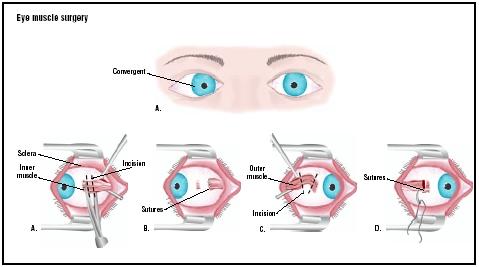
There are two methods to alter extraocular muscles. Traditional surgery can be used to strengthen, weaken, or reposition an extraocular muscle. The surgeon first makes an incision in the conjunctiva (the clear membrane covering the sclera), then puts a suture into the muscle to hold it in place, and loosens the muscle from the eyeball with a surgical hook. During a resection, the muscle is detached from the sclera, a piece of muscle is removed so that the muscle is now shorter, and the muscle is reattached to the same place. This strengthens the muscle. In a recession, the muscle is made weaker by repositioning it. More than one extraocular eye muscle might be operated on at the same time.
Eye muscle surgery is performed with the eye in its normal position and usually takes an hour and a half. At no time during the operation is the eye removed from the socket. The surgeon determines where to reattach the muscles based on eye measurements taken before surgery. Most of the time, it can hardly be seen except with magnification.
Diagnosis/Preparation
Depth perception (stereopsis) in humans develops around the age of three months. For successful development of binocular vision and the ability to perceive three-dimensionally, eye muscle surgery should not be postponed past the age of four years. The earlier the surgery, the better the outcome, so an early diagnosis is important. Surgery may even be performed before the child is two years old.
Patients (or their caregivers) should make sure their doctors are aware of any medications that they are taking, even over-the-counter medications. Patients should not take aspirin , or any other blood-thinning medications for 10 days prior to surgery, and should not eat or drink after midnight the night before.
Aftercare
After surgery, the eyes feel scratchy, but not very painful. Postoperatively, the eyes are also a little red and watery. There may be some hemorrhage under the conjunctival membrane over the white of the eye that usually settles over a period of two to three weeks. It usually takes on a yellowish discoloration similar to a bruise as it clears. Sometimes there is some thickening of the membranes over the eye, which can take several more weeks to clear. Very fine dissolving sutures are used to reposition the conjunctival membrane at the end of surgery and, until these sutures dissolve, there may be some scratchiness in the eyes. This feeling usually disappears after two or three weeks.
There will also be some swelling and discharge after the surgery. The swelling is usually minor, and patients should be able to open their eyes within the next two days, as the swelling should gradually disappear.
Patients will need someone to drive them home after the operation. They should continue to avoid aspirin and other nonsteroidal anti-inflammatory agents for an additional three days, but they can take acetaminophen (e.g., Tylenol). Patients should discuss what medications they can or cannot take with the surgeon. Pain will subside after two or three days, and patients can resume most normal activities within a few days. Again, the period of recovery may vary with the patient and the patient can discuss with the surgeon when to return to normal activities. Patient's should not get their eyes wet for three to four days and should refrain from swimming for 10 days. Operated eyes will be red for about two weeks.
Adults and children over the age of six often experience double vision for a limited period of time after surgery. Children younger than six sometimes will have double vision for a short period of time. Double vision is rarely permanent.
Patients generally do not have to wear patches after surgery, although occasionally a temporary patch may be recommended. They are usually required to use eye drops for a week until the follow-up examination. If the eye is healing on schedule, then the eye drops are usually discontinued at that stage. A further postoperative appointment is usually made for six to eight weeks later, by which time the eye will have stabilized.
After surgery for strabismus, the patient usually needs corrective lenses and eye exercises (vision therapy) if binocular vision is to develop.
Risks
As with any surgery, there are risks involved. Eye muscle surgery is relatively safe, but very rarely a cut muscle cannot be retrieved. This, and other serious reactions, including those caused by anesthetics, can result in vision loss in the affected eye. Occasionally, retinal or nerve damage occurs. Permanent double vision is also a risk of eye muscle surgery. The success rate of this surgery varies from person to person and depends on each person's particular condition.
Some infrequent complications include, but are not limited to, allergy to the sutures, bleeding, and change in pupil size.
The major risk of eye muscle surgery is failure to achieve a satisfactory alignment of the eyes. This may be an undercorrection or an overcorrection, with the eyes turning the other way after the operation. Surgeons aim to achieve perfect alignment, but this is not always possible. If the alignment is still unsatisfactory at the final postoperative visit, then a second operation may be required.
Infection is an unusual postoperative complication and can be treated with antibiotic drops.
Because an incision is made through the conjunctiva and muscle, there is always some residual scarring. Usually, this is detectable only under a microscope, although it may be possible to see it on close examination.
As with any eye surgery, there is a potential risk of visual loss from strabismus operations, but this is a very rare complication.
Normal results
Normal results of eye muscle surgery are an improved alignment of the eyes and improved cosmetic appearance without complications. The surgery usually has a very good outcome.
Morbidity and mortality rates
Cosmetic improvement is likely with success rate estimates varying from about 65–85%. According to the latest statistics from 1998, binocular vision is improved in young children about 35% of the time, following eye muscle surgery. Between 15 and 35% of patients have either no improvement or a worsening of their condition. A second operation may rectify less than perfect outcomes.
Alternatives
Surgery is not the only treatment to correct eye muscle disorders. Options and outcomes vary considerably based on such factors as the presence of double vision. Nonsurgical treatment is also available, such as orthoptics and vision therapy.
Orthoptics
Orthoptics is a medical term for the eye muscle training programs provided by orthoptists and optometrists. Vision therapy programs include orthoptics, but there are broad differences between vision therapy and orthoptics. Orthoptics dates back to the 1850s and is limited in scope to eye muscle training and the cosmetic straightening of eyes. Orthoptics treats muscle problems by considering only strength; it does not focus on neurological and visual-motor factors as vision therapy does. Treatment is home-based.
Vision therapy
Vision therapy is an individualized, supervised, non-surgical treatment program designed to correct eye movements and visual-motor deficiencies. Vision therapy sessions include procedures designed to enhance the brain's ability to control:
- eye alignment
- eye teaming
- eye focusing abilities
- eye movements
- visual processing
Visual-motor skills and endurance may be developed through the use of specialized computer and optical devices, including therapeutic lenses, prisms, and filters. During the final stages of therapy, the patient's newly acquired visual skills are reinforced and made automatic through repetition and by integration with motor and cognitive skills.
Resources
books
Dyer, J. A., and D. A. Lee. Atlas of Extraocular Muscle Surgery. Westport, CT: Praeger Publishers, 1984.
Good, William V., and Craig S. Hoyt. Strabismus Management. Boston: Butterworth-Hienemann, 1996.
Roth, A., and C. Speeg-Schatz, eds. Eye Muscle Surgery. Lisse, The Netherlands: Swets & Zeitlinger, 2001.
Salmans, Sandra. Your Eyes: Questions You Have…Answers You Need. Allentown, PA: People's Medical Society, 1996.
von Noorden, Gunter K. Binocular Vision and Ocular Motility: Theory and Management of Strabismus, 5th edition. St. Louis: Mosby-Year Book, 1996.
periodicals
Bosman, J., M. P. ten Tusscher, I. de Jong, J. S. Vles, and H. Kingma. "The Influence of Eye Muscle Surgery on Shape and Relative Orientation of Displacement Planes: Indirect Evidence for Neural Control of 3D Eye Movements." Strabismus 10 (September 2002): 199–209.
Mayr, H. "Virtual Eye Muscle Surgery Based upon Biomechanical Models." Studies in Health and Technology Information 81 (2001): 305–311.
Murray, T. "Eye Muscle Surgery." Current Opinion in Ophthalmology 11 (October 2000): 336–341.
Rubsam, B., W. D. Schafer, B. Schulte, and N. Roewer. "Preliminary Report: Analgesia with Remifentanil for Complicated Eye Muscle Surgery." Strabismus 8 (December 2000): 287–289.
Watts, J. C. "Total Intravenous Anesthesia Without Muscle Relaxant for Eye Surgery in a Patient with Kugelberg-Welander Syndrome." Anaesthesia 58 (January 2003): 96.
organizations
American Academy of Ophthalmology. 655 Beach Street, P.O. Box 7424, San Francisco, CA 94120-7424. http://www.eyenet.org .
American Academy of Pediatric Ophthalmology and Strabismus (AAPOS). http://med-aapos.bu.edu .
other
Olitsky, Scott E., and Leonard B. Nelson. Strabismus Web Book. http://www.members.aol.com/scottolitsky/webbook.htm .
Kellogg Eye Center: Eye Muscle Surgery. http://www.kellogg.umich.edu/patient/surg/eyemuscle.html .
Pediatric Ophthalmic Consultants Webpage: Strabismus Surgery. http://www.pedseye.com/StrabSurg.htm .
Lorraine Lica, PhD Monique Laberge, PhD
WHO PERFORMS THE PROCEDURE AND WHERE IS IT PERFORMED?
Eye muscle surgery is performed by surgeons with specialized training in eye surgery. These physicians are usually board-certified ophthalmologists and fellowship-trained pediatric and/or adult strabismus specialists.
The surgery is almost always performed as outpatient surgery ; that is, the patient comes into the hospital or day surgery facility the morning of the surgery and goes home the same day.
QUESTIONS TO ASK THE DOCTOR
- What is the chance of needing a second operation?
- What are the possible risks and complications?
- Will I need eyeglasses?
- How much eye muscle surgery do you perform each year?
- Are there alternatives to surgery?
- Is a patch worn after surgery?
- Are there any scars after surgery?
should i have vison theropy??
I recently saw an opthalmic surgeon, first time for 10 or so years. As an afterthought i asked her opinion re: surgery to correct divergent squint in my L eye. Basically she suggested that unless my appearance was an issue, probably not worth it as it was unlikely to have long term results as my brain has compensated (i'm 28).
Thank You.
Wayne ( coolwes )
i have alternative squint.i did eye muscle correction on right eye.after that i felt double vision.doctor told that he corrected 7mm inwards the nose side and the deviation of eye is more than 45 degree outwards before the surgery.can i get my normal vision?
I'm 37 years of age and suffering from double vision. Does any one have any advice.
Dee Parmar
i am 14 yrs and i was woudering if i should get this surgery my r eye doesnt move like it should. i tried the visual therpy when i was 8 and it didnt help i am thinking about doing this sugy but i dont no if i should do it please contact me if u think i should.
Susan
My age is 26 year old. Doctor say’s in my eye's have an alternative squint .But my eye's visions are 6×6 & .I have wears the glasses about 0.5 no. in the both’s eye’s. but doctor say’s my eye’s squint is very large . It is not possible to correct the eye’s upto 100% . He say’s it is correct upto only 50 % after one surgery . Please tell me about how many surgery are required to correct the alter native squint upto 100% . I want to know it is possible or not possible & I want to know about any another alternative to correct alternative squint eg. Vision therapy.
I am very thankful to u If u guide me
i am now 22 and have found that the vision in my left is worse where i now have pin whole vision in my left eye and i am unable to focus on whole pictures. i cannot properly see out of it and the doctors keep saying that its down the my brain wirering as a child.
my right eye is not so bad but due to my reliance on that i am becoming more short sighted and often get muscle aches or head aches. i am unable to read or use a computer for more than 30 minutes before i get some form of ache or pain.
So now i have some doctors saying its my brain, others saying that its the muscles or that the scar tissue is causing the proble because of the surgery as a child. Some say my eyesight will therefore get worse or they just don't know.
Does anyone have any ideas?
Thank you
my daughter is about 4 years old and have alternative divergent squint any good qulafy doctor you adivse me to make the surgery
I have had eye muscle surgery and I didn't have double vision afterwards.
I think that you should get the surgery done. I went to Robert O. Hoffman, at the John Moran Eye Center in Salt Lake City, Utah; He has been my doctor for years, and I really trust him. I'm 16 and I've been teased about my eye my whole life. It is really nice to have my eyes aligned and no one knows that anything was ever wrong with it now, rather than just staring at me...
I hope this helped!
I am almost 38 years old and have had strabismus my whole life. By going to a specialist I have learned that I have had this my whole life but have been able to correct my double vision all these years until about 2 years ago. Prisms in my lenses no longer work for me and surgery is now my only option. I have 4th nerve palsy in my left eye. Anyone ever heard of this and has anyone has this type of surgery before? Any advice would be helpful.
Thanks.
Kim
Again she had to use Eye Patching to gain vision on the left eye, on her first day for vision test the result was negative. She has to use Eye Patching the whole day for 3 months. On the 2nd month she went to vision test again the progress was good she saw the black line in front of her.
On this time the doctor suggested for early eye muscle surgery, my question is why dont I continue to use Eye Patching since the result of this therapy is positive? I am thinking to wait when she become 2 years old before to decide for surgery. In 1 year I am still very hopeful for the good effect of Eye Patching then if there is no effect anymore that`S the time of me to decide.
I would like to hear your own opinion.
I had 4th nerve palsy surgery a week ago. I was covering an eye (either eye, didn't matter which) to see if I got tired and thought I finally needed glasses. (I am 43) Like you, I had this my whole life and it took this long for it make itself known. Oddly enough, I still have 20/20 vision except for the nerve palsy thing. The doctor weakened the muscle on the other side of the muscle to compensate for the weak muscle. I have been seeing double since the surgery but my vision is improving every day. I spoke with my doctor today and we will know in about 5 to 6 weeks for sure if any follow up adjustments are necessary. All in all, feeling good, just very sensitive to fluorescent lights at the moment.
Thanks,
Cheryl
Thanks,
Tommy Phipps.
I'm an 18 yrs old girl, who had an accident when I was 5 yrs old.
A very small piece of glass when acrossed my iris and it left me a scare. The surgery was successful because the doctor was able to remove the glass without removing my vision. The scare was the main reason why I am having a very poor vision.
I needed to wear eyeglasses after the surgery but then, I can't exactly remember why I stopped wearing it.
When I was in freshmen, I told my mom that I need to see a doctor so she looked for another doctor coz we couldn't find my old doctor, who did the surgery. So my mom and I told the doctor about my history.
The surgery was successful Although my vision was very poor and I didn't have any lazy eye. But few years after, I notice that my eye is slowly shifting/drifting. I wasn't the only one who notice it. Even the photographers, my teachers, friends,etc.
I remember when I was in grade school, some people would ask me "Where am I looking at? or Who am I look??" Before I just ignore it. BUT NOW, it hurts me emotionally and it really pulls down my self-esteem. :-(
As a teenager, our eyes are really important especially when we communicate. And also as a nursing student and a dancer like me, who has so many gifts to share. BUt I just can't bring my best to all my recitals or performances because of my low self-esteem.
My question is "Is there any specific vision rate/level??" because my vision is really poor.
"WIll this eye muscle surgery work??" for a patient like me, who has allergy (skin + rhinitis + eye), accident and a very poor vision..???
PLEASE help me. I've really been anxious about this issue. Thank you.
My son is nine years old, he got congenital 4th nerve palsy but it doesn't affect his appearance. The only problem is his double vision, he wont have double vision unless he is very tired or not concentrated. Shall I let him go for the eye surgery?
Many thanks!
jessica
I am just turning 66 years old. Started noticing double vision about 5 months ago. My Right eye turns in. How common is this in older folks and will therapy help or is surgery required?
How can I find a therapist?
Read more: Eye Muscle Surgery - procedure, recovery, blood, pain, complications, adults, time, infection, operation, types, risk, children, rate, Definition, Purpose, Demographics, Description http://www.surgeryencyclopedia.com/Ce-Fi/Eye-Muscle-Surgery.html#Comments_1#ixzz15BhOfS12
The surgeon says he cannot work on the bottom muscle as there was too much scaring and trauma to that part of the eye and they can probably go in and adjust the top muscle. YOur comments please
and how do I get a second opinion.
Thanks.
i had horizontal squint in my lift eye from my bourn time .and i did the surgery for the squint when i was 22 years old . now i am 27 years old and my eyes tourned back to anather side.
so please let me know that the second time surgery will be good or not . and what can i do to find positive result for my eye.
thanks. Eng shiar Ahmad Siall
specialist.
Please advise me what to do.
sincerely
huntley walker
My name is Stephanie and am 20 years old. I've had stabismus since i was born as well as a condition called morning glory disc. I am totally blind in my right eye, and also have been since i was born. I went in for eye muscle surgery 2 weeks ago for cosmetic reasons and am pleased with the results. I had the best opthamoligist in the world, Dr. Droste out of Grand Rapids, MI perform the surgery (he is the only once ive seen since i was 6 months old). I went my whole childhood and high school career with an eye that was pretty severly turned in. The doctor said i should have psychological issues because of it, but i always accepted it. I'm fairly attractive younger girl, so i guess cosmetically people were able to see past my eye. My whole life I had to face one way for pictures, avoid standing on the left side of someone or was not excited to meet new people. This surgery has changed my life. Though it's only been two weeks and my eye is still a little red and puffy, I can notice a change in the way I am on a daily basis. The first great thing was being able to be straight on with a camera and say "CHEESE!". I did notice however almost a sense of sadness recently, like i've lost something that made me unique. I have a confidence now like "look at my new eye every one!", but to people who dont know me, it means nothing because its normal for people to have straight eyes. So i guess im swimmin with the fishes now with 2 straight eyes which is alright, but i do miss having that uniqueness. I am still blind in the eye and always will be, so i guess thats unique enough =).
And to Brandon, the first 4 days after my surgery, i thought he over corrected my eye too, it definetly was wondering a bit. But after i returned to work on the 7th day after surgery, my eye started to turn in on that day and was pointing back towards my nose. Starting after the 8th day of surgery my eye has been completely straight and perfect.
God made all of us the way that we are, but unfortunatly being able to make eye contact with another person is important to us which is why this surgery is important. Good luck to everyone who all has special cases and circumstances. Take care!
the optical nerve if my sisters eye has been cut by the doctor as it was effected by the cancer tissues. she is not able to see now, not even reflection of light in her eye. is it possible that she will see the world again... please do help me...
My daughter is 15. The doctor says the percentage of crossing is 20%. Will surgery help or is it a waste of time? She wears bi focals now and will need to wear reading glasses even if she can wear contacts. I don't know what to do.
My name is Wajid shakir. I want to discuss my eyes are going inside gradually. And i am worried about them. I want to make their appearance at outer surface. It is making my look as old. so please give me suggestion that what treatment i have to do with them.
Best Regards
wajid.shakir@yahoo.com
In Armenia we don't have niether Botox nor the specialist of paralytic strabismus Botox injection.
And I would like to know if after Botox the eyes can be fixed. Thank you.
My age is 26 and my eyesight is too weak right eye's number is above 5 and left is more then 6 i think it is 6. something i want to ask you that if i will be blind that what will be option for me? surgery or? and when i should do surgery ? when it will be suitable? would i be see completely after surgery and what types of surgery here? i dont know about it that what i have to do now? surgery or contact lenses? so kindly suggest for me right path please i am much worry about my eyes/
Thanks
I'm 48 years old and was diagnosed with over active thyroid disease two years ago. Since then my thyroid is back to normal. And my left eye swelled up and left scare tissue witch restricts the movement of my left eye. Now I've had 2 surguries on my bottom eye muscles to corret my vision. The first surgery was not a success and the second surgery was 5 weeks later and it was good at the start but went back to where it was before. Now my left eye is looking up and the other is normal/good. Now my doctor wants to operate on both eye's at the same time to adjust them together.He plans on doing this in 6 months so my eye heals up good from the previous surgeries. My concern is if he operates on both eyes are they going both going to be looking up or are they going to be fine.
Looking for light at the end of the tunnel. Arnold ar.fo@live.com
Now, with the age of 60, three weeks ago, I had surgery in the left eye to correct the divergent strabismus, with only cosmetic purposes.
Now the eyes are straight when I fix with the right eye and slightly divergent when I fix with the left eye. Can this be corrected with appropriate lenses or must I have another surgery?
sir/madam, please give me some suggestion is there any treatment for these type of cases. If there is no treatment what about my future. is there any chances to effect both eyes.
appreciate any help or advice.
first of all, posting your complex history of strabismus etc. in this guestbook does not bring you any further, see a professional instead.
Sharing my story, I hada surgery on my left eye which squinted outwards. Left muscle was weakened in a surger with a pleasant outcome. Two years later, my eye starts to quint upwards from time to time and I am going to see the doc again. The squint especially happens when I am tired, nervous, a bit tipsy (!) etc.
my daughter has got duane syndrome on her left eye. doctor has done eye patching for one and half month. but reslult is same. now they are asking to wear the glassess. if that also wont give any result. then they want to go for surgery. wearing glasses are good or bad at this age (1.8 years). is any other way to cure it.plz let me know
i was born with some sort of tissue in the corner of my eye and it's quite visible, i'm not sure what it is exactly but you can see the lump in the corner of my eye when i close it. I've searched everywhere to see if anyone else has the same condition but i cant find anyone. This tissue thing has not effected my vision in anyway, it's just irritating.
I was born three months premature, and due to this, my left eye has a damaged nerve. I can see out of it but not perfectly. I do wear glasses but they are necessary. My left eye is kind of like a lazy eye. It isn't aligned so it goes more to the direction of the tip of my nose. My left eye has always been a problem to me and it has always weakened my self-confidence. I try to ignore it but it's hard for me to socialize with new people due to the fact of how my left eye might look to them. I have always wondered about surgery but I'm worried that if I go through it, I'll end up not being able to see out of my left eye ever again because of the damaged nerve. I want to know if this will benefit me or make it worse or if I can even do this. I'm also only 17 years old but I really don't want to live with my crooked left eye for the rest of my life. Please, help.
HOW ARE YOU I WANT TO KNOW THAT MY GRAND MOTHER IS RECENTLY FACING VERY ACUTE DISEASE ABOUT EYE WHEN WE GO TOO CHECK OUT TO DOCTOR THEY SAID THAT THEIR BRAIN MUSCLES ARE NOW VERY WEAK SO THERE IS NO CURE TO THIS DISEASE SO I WHAT TO KNOW THAT IS THERE ANY CURE THAT MADE SOME CONTRIBUTION TOO SEE THE THINGS MAIN THINGS WHICH CAUSES TENSION IS THAT THEY CANT SEE NAY THING NOW AND IF A PERSON IS SITTING JUST AT THE RIGHT AT SEAT SHE CANT SEE THAT PERSON AND ALWAYS SPEAK WHO IS HE???AND MANY MORE SO PLEASE HELP ME TELL ME ABOUT THE MEDICENE THAT HELP HER
WAITING FOR YOUR REPLY
'
First off, what an interesting post I stumbled upon. I am a 48 year old male who has had a "lazy eye" his entire life. I was born premature by 2 months. I was told I was born "cross-eyed", and that I had eye surgery at 6 months to correct my crossed eyes. I have worn glasses (contacts) all my life, and continue to wear them now.
My right eye - as the optometrist calls it - is known as the "lazy eye". My right eye turns outward. I've tried - hard as it may be - to act normal like the staring doesn't bother me. I dread having to look "into" a camera lens for a picture. It's downright embarrassing to see the picture, only to see myself staring somewhere into space! Over the years I've compensated and have learned "how" to take a normal picture. I literally have to look to the left of the camera (as it points toward me) so my right eye can be somewhat aligned. The other day I was having a conversation with another person. I was sitting; the other person was standing about 5' away from me. I tend to look into the other person's eyes (my left eye to their right eye, and vice versa). So, when I was talking I guess my right eye was looking somewhere "past" the other person's left eye. How embarrassing it was for me when he turned to look over his left shoulder (because he didn't know where I was looking!) I could have crawled up into a little ball (and I'm 47 years old!!)
To all of us that have any eye condition; I have empathy for you. It's not easy dealing with "lazy eye", etc. My wife and I purchased our first ever 3D LED TV about 1 year ago. My daughter and my wife enjoy watching Blu-Ray movies in 3D. Me... well... I watch the movie (with the glasses - they hurt my vision) but in 2D. We went to Disneyland last September (2012) and went on several 3D rides. While my wife and daughter were having the time of their lives (Transformers at Universal was incredible, even for me), I was left videoing the rides while I watched them in 2D.
I suppose I can't miss what I have never known. Still... being able to see just one vision would be so nice. Because of my condition, I have double vision. For me, the vision in my right eye is just to the left of the vision in my left eye. Most of the times my brain compensates by "blocking out" the right eye. I wear glasses (contacts) in both eyes. I have very poor vision in my right eye. Though the vision is my right eye is clear and sharp, I cannot focus in on a pin-head, etc. I have no idea where the "centre" of an object is. I just think I have some blind spots in my eye.
I have discussed my condition with more than one eye doctor. They just say I could end up with permanent (?) double vision. Heck... what do I have to lose.. I have double vision now.
I consider myself to be a tough guy...one with a thick skin. But all that goes away when I'm having a conversation with somebody and just know my right eye is off in la-la land. I know I can compensate by looking away (with my left eye) so my right eye is in alignment (if you know what I mean), but the problem with that is I am not directly looking at the person (with my left eye... and my right eye is useless for focusing).
As I write this I am becoming choked up with emotion. I felt I was one in a million with my eye problems. It's so nice to know I am not alone. I feel embarrassed that at 47 I can get emotional with my "lazy eye".
I did some research and have located a Doctor where I live that may be able to help me gain some balance in my life. Not sure whether my condition can be fixed (by surgery or other means) but I am ready to take the next step. I told my wife I would like to have eye surgery to fix my lazy eye...trouble is I think it's more than just a lazy eye.
People - we stand together. There are more like us than I ever knew. I am so proud of everyone that has posted here. It takes great courage to open up to strangers. God bless. If nothing else at least I was able to post here and at least get it off my chest.
In my case, I have learned that I have had a neurological issues since childhood and the "lazy eye" was just one manifestation of a much bigger problem; an effect rather than a cause of my other issues. I have dyslexia, a kind of "lazy brain" syndrome, although i can assure you that as someone with a masters degree in finance my brain has hardly been "lazy". I am dealing with some symptoms of dementia at the moment ( memory loss, inability to think critically or keep focus on a thought. Loss of words when speaking and/or writing) and as I age i worry that it might lead into something much worse and that i may not even be able to take care of myself. I lost my job five years ago and have been unable to find work since so this operation is coming out of my already empty pockets with only hope of some relief as a reward.
I urge everybody to have their vision problems and lazy eye evaluated as early as possible and in conjunction with a visit to a neurologist to find our the reasons for the lazy eye. Parents, please don't take some eye crossings in your child lightly and laugh it off as an amusing joke like my parents did with me. It can potentially ruin your child's future and all hope for a normal life
good luck to all
I went to a specialist when I was 18 - only to be told to forget about an operation as I "would only end up with double vision" and why would a pretty girl like me care about something so trivial "it's not as if you squint all the time"!!! It has taken me over 20 years to seek another opinion. I wish I had done that years ago. I went to the best eye hospital in the World (Moorfields in London). They tested me for 2 hours (eg to see IF there's a chance you could develop double vision!) and told me they can make it a lot better - if not fix it completely. Please feel free to email me with questions! x
I am 19 years old and have duane's sydrome, retraction type 1 in right eye. I also have enophthalmos in that eye, though very slight. My girlfriend broke up with me for it, felt worst for it. Is there any surgery that can reduce atleast enophthalmos? My eyes looks more weird when I see towards left side and my left eye appears bigger and out and right eye moves inside, so appears small.
If an eye muscle is lost during surgery, is there a way to fix it?
If not, what kind of time frame are we looking at before this tech is possible?
Being lost, does it disintegrate when not being used?
Would we be able to use stem cell research to create new muscles of the eye?
If we were able to re-create the eye muscle, would the nerve used to control it be forever lost?
What is the average time it takes for an eye to regain sight after being turned back on by brain due to eye realignment?
What are the chances that an eye will not regain operation after being realigned?
If the procedure of finding or recreating the muscle exists, what is the average cost?
What do you think the projected cost would be in the future if it is not available now?
Thank you for any answers provided! :)
I am 25 and recently been diagnosed with Fourth Nerve Palsy. My Doc explained it is rare for someone my age to suddenly develop this condition. I played soccer and I am goalkeeper so typically I will get a head knock here and there. I remember getting a ball to the head about a year ago. Slowly after this occurrence I remember struggling with the lights. As months passed it got worse. One year on I saw my doc and he has although prisms will do the job surgery is def an option. The only problem I am might be facing is the face that typically if this is a result of an injury the symptoms should start right away and not develop. Mine however has developed over time. I recently got a blood test to see if it isn't some kind of muscle condition..hopefully not.
Anyway just thought I would share.
I'm 85, have had cataract surgery in both eyes, new lenses. Done 1 year ago. All was perfect,no longer needed glasses to see far still needed glasses to read. Driving license upgraded to not needing glasses. Suddenly double vision. Checked with cateract Dr. He noted all looked ok. And recommended a neurologist.
Neurologist ordered carotid artery test, MRI, brain and blood tests, all ok.
She says the problem looks like nerve muscle problem. Recommended eye exercises, and to see her in 6 weeks. I need a second opinion!
My age is 25 , When my age 8 year that time my left eye accidentally damaged.that time we done operations. but I am not saw this eye .so please suggest me about this.
I have down beat nystagmus in primary position and more nystagmus in down gaze with higher amplitude and frequency and in lateral gaze - I develop horizontal gaze evoked nystagmus and high frequency and in up gaze has less vertical and down beat nystagmus - my null point is in up gaze - Saccades are fast, but interrupted by nystagmus.
So, I recently saw a different neuro-ophthalmologist (other neuro-ophthalmologists have told me that there is nothing that can be done except taking high doses of muscle relaxers for the last 12 years). This new neuro-ophthalmologist told me that there is currently a surgery being performed - Dell’Osso a.k.a. tenotomy and reattachment a.k.a. T&R. I am considering it. I was told that the 2 big risks are anesthetic issues like any other surgery and that the surgery may not work; not a real risk that my vision could get worse or that I could go blind. Obviously there are tons of "real" factors to consider, but I am curious about the price?
My questions are: 1. Has anyone had this surgery - experience? 2. Did anyone hear stories of it helping or hurting? 3. What are the average costs? 4. Is the surgery covered by medical insurance (or only by vision)?
One general question that I have is whether anyone had nystagmus and could no longer drive, and something changed (medication or surgery) wherein that person may now drive. Experiences/stories?
Thank you for any input!
Can you help?
PLEASE let me know. Thank you
Good Luck Friends,
Lynn
parking space or to drive into my garage. It is my understanding that the misalignment of my eyes also is a cause for falling. When I fall, it is always related to depth perception. To help me to deal with Parkinson’s - I go the gym 3 times a week (use weight training equipment, elliptical machines, stretching machines, and complete my Tai Chi, routine.) I take Tai Chi class for 1-1/2 hour each week and practice Tai Chi 3 other days each week. I also walk 3 days each week. I am controlling my Parkinson’s well but still I will fall because If my depth perception problem. Can I and should I get surgery for my weak muscles to improve my depth perception problem or with my other health concerns such as Macular Telangietesia (Type 2,) it may not and could cause me additional problems? If I should, what experience should I look for in my eye surgeon?
Thank you for your assistance,
Toni
This really affects my whole life, my work and my social attitude. I am working as Human resource personnel and has to face different persons everyday. I am have no problem with the blindness on the right eye since it is not obvious but the misalignment of my eyes seems disturbing. They usually ask me where i was staring at when i am talking to them. Not everyone do understand my situaton, my very few close friends do know about it but not everyone. Is Eye-muscle surgery the answer to my problem?I wish you could help me.
I have had 4th nerve for at least what i suspect 10 years, im currently 27 years old...
I also have a head tilt which has only become apparent in the last 10 years maximum and slowly seems to get worse, i have another issue where my pupil is not dilating / constricting to light as it should ( currently under going a barrage of tests ) had an MRI not going for a High contrast with blood tests etc etc..
overall VERY worried to be honest, im healthy other than this damn head tilt + this pupil issue.
Now I really would like some opinions please, I have been told my a dedicated squint surgeon that my head tilt is one of the worst ones she has seen and i will need 2-3 operations to correct my eye misalignment, i currently have 20/20 vision and NO diplopia, only if i put my head upright...
I struggle with neck pain towards the end of the day, but my biggest worry is surgery giving me double vision, can anybody give me some advice on their own stories please, feel free to email me personally :)
I am 16 and I have had a lazy eye near enough since I was born. As a child, i were given glasses to try and treat my condition. However, I have always had perfect vision so the glasses did nothing to me, apart from not being able to see probably. Next week, I will be going for my first eye muscle surgery and as I am scared, I am also excited. However, if it does go wrong I was wondering whether or not I would still be able to halfy control my lazy eye to set it straight. My lazy eye normally just comes out when I am tired, stressed. Although when I am concentrating or trying not to show it, it is fine. Does anyone who has undertaken this surgery know if this will continue if the surgery does not work?
Thank you!
Any ideas?
Good luck to those who choose to do this surgery. Chances are you'll be very happy and I most certainly recommend it.
I am now 58 yo.
The doc said that there could be a double vision and if it's not necessary,I should not do it.
Can someone tell me HOW LONG WOULD A SURGERY LIKE THIS TAKE?If I remember correctly,my doc said 4 hours.
Any advice?
Appreciate!
Thank u Suze